

Molybdenum in 90–99% purity – as raw stock, rod, wire, sheet or TZM alloy, ex stock.
Enquire now with E.WAGENER, with no obligation.
Molybdenum
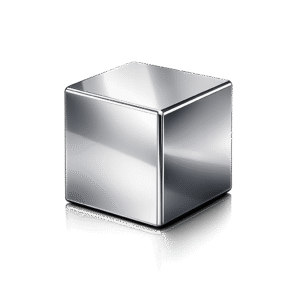
Available short-term
Atomic number · 42
Mo
Molybdenum
Atomic weight95.96 g/mol
Density10.22 g/cm³
Melting point2617 °C
Boiling point4639 °C
Purity (max.)> 99 %
Ready for your quote? Non-binding, free of charge, personal.
Enquire nowMolybdenum (Mo) – Semi-Finished Products, Alloys and Custom Components Ex Stock
Molybdenum (chemical symbol Mo, atomic number 42) is a silvery-white, lustrous heavy metal from the group of refractory metals – that is, high-melting metals with a melting point above 2,000 °C. With a melting point of 2,617 °C, a density of 10.22 g/cm³ (only about half as heavy as gold) and high hot strength, molybdenum is one of the technically most demanding industrial metals. The ductile and polishable metal is hard and brittle, but can be processed well.
Worldwide, molybdenum is mostly obtained as a by-product of copper mining – the main producing countries are the USA, Chile, Peru and Canada, as well as China. Around 300,000 tonnes of molybdenum are processed worldwide every year.
E.WAGENER supplies molybdenum in a wide range of forms, alloys and processing stages – suited to your respective application.
Molybdenum – a Sought-After Metal for High Performance
The high melting and boiling point (4,639 °C), together with good thermal conductivity and excellent dimensional stability, make molybdenum so interesting for industrial applications, e.g. for melting furnaces, as a stirring tool and for tools used in industrial settings. Paired with high corrosion resistance, molybdenum offers you a high-performance material from which semi-finished products and tools with long service lives can be made.
Molybdenum is processed into rods, wires, sheets and tubes, which are used, for example, in the lighting industry, in glass manufacturing, as components for jet engines and rockets, and in high-temperature nuclear reactors.
At the same time, molybdenum offers good thermal conductivity combined with low thermal expansion. This also makes molybdenum a popular material in semiconductor substrate manufacturing or for power electronics. As a base plate, molybdenum reliably dissipates the heat generated at high power densities. In coating technology, molybdenum sputtering targets are used, for example in the production of thin functional layers for flat-screen displays. Molybdenum is also in demand in medical technology due to its corrosion resistance to molten metal and glass.
At E.WAGENER you can get molybdenum in pure form as well as an alloy, or even already processed into the semi-finished product or component you require.
Molybdenum Alloys for Targeted Applications
The material properties of molybdenum can be further fine-tuned through alloying. Even small additions of Mo significantly increase the hardness, toughness and corrosion resistance of molybdenum-alloyed steels. Ferromolybdenum is used for this purpose: an iron-molybdenum alloy with 60–70% Mo. Besides iron-molybdenum alloys, we offer you a wide variety of alloys with copper, rhenium, chromium, lanthanum oxide, tungsten, niobium, tantalum, or the popular TZM alloy (titanium, zirconium, molybdenum).
Rhenium increases ductility here and lowers the ductile-to-brittle transition temperature, making the material easier to process even at lower temperatures. Titanium, zirconium, carbon and rare-earth oxides serve as further alloying elements to specifically adjust strength, recrystallisation behaviour and creep resistance. Enquire about your desired alloy without obligation, or get advice on what is particularly suitable for your application.
Molybdenum vs. Tungsten
Molybdenum is in the same group of the periodic table as tungsten and therefore shows similar physical properties. The most important practical difference: molybdenum has a significantly lower density and a lower ductile-to-brittle transition temperature than tungsten, meaning it is easier to process while offering comparable high-temperature resistance.
Get Molybdenum from E.WAGENER – Pure or as a Component
You can determine the degree of purity of the molybdenum yourself at E.Wagener. We supply you with 90%, 95% or even >99% pure molybdenum. In addition to supplying the pure material as powder or raw stock, we process your order into blocks, wires, rods, or even sheets and foils as needed. Besides supplying the material, E.WAGENER also offers the production of custom components. Since we have excellent know-how in processing special metals, you benefit not only from careful craftsmanship but also from a knowledge advantage that should not be underestimated.
Molybdenum in metallic form is considered comparatively safe; however, machining (e.g. grinding, welding) can generate dust and fumes that must be handled according to the safety data sheet. On request, we will provide you with the safety data sheet for the respective alloy.
Frequently Asked Questions about Molybdenum
What is molybdenum?
Molybdenum is a silvery-white heavy metal from the group of refractory metals with a melting point of 2,617 °C. It is characterised by high hot strength, good thermal conductivity and low thermal expansion.
What is molybdenum used for?
Molybdenum is used, among other things, in melting furnaces, in the lighting and glass industries, in jet engines and high-temperature nuclear reactors, as a sputtering target in coating technology, and as a base plate in power electronics.
Is molybdenum the same as tungsten?
No. Both metals belong to the group of refractory metals and are similar in many properties, but molybdenum is lighter and easier to process at lower temperatures than tungsten.
In which purity grades does E.WAGENER supply molybdenum?
E.WAGENER supplies molybdenum in 90%, 95% and over 99% purity – as raw material or already processed into blocks, rods, wires, sheets or foils.
Which molybdenum alloys does E.WAGENER offer?
Besides pure molybdenum, we supply alloys with copper, rhenium, chromium, lanthanum oxide, tungsten, niobium, tantalum, as well as the TZM alloy (titanium-zirconium-molybdenum).