

High-melting, malleable and permanently corrosion-protected.
E. Wagener supplies niobium pure, as powder, or fully processed into rod, wire, sheet and custom components.
Niobium
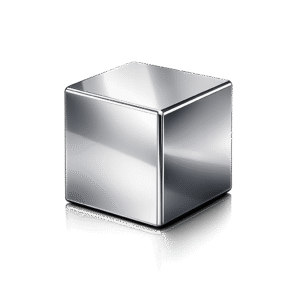
Available short-term
Atomic number · 41
Nb
Niobium
Atomic weight92.91 g/mol
Density8.57 g/cm³
Melting point2477 °C
Boiling point4742 °C
Purity (max.)> 99 %
Ready for your quote? Non-binding, free of charge, personal.
Enquire nowNiobium (Nb) – Semi-Finished Products, Alloys and Custom Components Ex Stock
Niobium (chemical symbol Nb, atomic number 41) is a grey, lustrous heavy metal with a very high melting temperature (2,468 °C) and is not unlike the chemically related tantalum – but with a significantly lower density. Due to its low hardness, the pure metal can be processed well; however, minor impurities from carbon make it considerably harder and more brittle. Niobium is a relatively base element: in air, a protective oxide layer forms that protects it from further corrosion and causes the colourful shimmer seen when heated. Niobium powder is pyrophoric and can therefore ignite spontaneously.
Niobium – a Fantastic and Underrated All-Rounder
Hardly anyone goes through life without encountering niobium, even though it is relatively unknown as a metal. Nevertheless, it combines several properties that make it a sought-after all-rounder. Despite its exceptional stability and strength, the metal is very easy to process, which is why it is often used in the construction of pipelines, high-voltage pylons or tall bridge pillars. Even the achievements of space travel would not have been possible without niobium: the Space Shuttle had tubes, screws and nuts made of niobium at its most sensitive points, to withstand the extreme temperatures on re-entry into the Earth's atmosphere.
The only catch: there are a full 41 metals that occur more frequently in the Earth's crust than niobium. Nevertheless, it is irreplaceable in some applications – for example in medical technology: the niobium-titanium alloy remains the standard material for superconducting magnet coils, as used in magnetic resonance imaging (MRI) scanners and particle accelerators.
Niobium Alloys Offer Almost Unlimited Possibilities
Materials with niobium alloys are generally characterised by increased mechanical strength. Even the smallest additions of niobium make steel significantly stronger and tougher. Anyone who has ever ridden a bicycle has very likely done so on rims made from a niobium-aluminium alloy, which ensures both lightness and stability. Niobium alloys are also indispensable in high-tech applications such as superconductors in particle accelerators at extremely low temperatures or in lasers.
Niobium vs. Tantalum
Niobium and tantalum are in the same group of the periodic table and always occur together in nature. At 8.57 g/cm³, niobium is only about half as dense as tantalum (16.65 g/cm³) and is easier to process. While tantalum is mainly in demand for capacitor manufacturing, niobium is dominated by use as a steel-alloying element and superconductor.
Get Niobium from E.WAGENER – Pure or as a Component
E.Wagener offers you individual options when ordering your material. From us you can get niobium in 90%, 95% or even >99% purity. But supply as powder or raw stock is not the only option: we process niobium into sheets, rods, wires, blocks or even foils exactly to your requirements. Or do you need special custom components? No problem. E.WAGENER has excellent know-how in processing niobium, allowing us to manufacture and supply even complex parts specifically to your requirements.
Since niobium powder is pyrophoric and can ignite spontaneously, the relevant safety data sheet must be observed during storage and processing – we will be happy to provide it to you on request.
Frequently Asked Questions about Niobium
What is niobium?
Niobium is a grey, lustrous heavy metal with a high melting temperature (2,468 °C) that resembles the chemically related tantalum, but is significantly lighter.
What is niobium used for?
Niobium is used, among other things, for pipelines, high-voltage pylons and bridge construction, as a steel-alloying element, and as a superconducting material in MRI scanners (niobium-titanium alloy) and particle accelerators.
Is niobium common or rare?
Niobium is relatively rare: 41 metals occur more frequently in the Earth's crust. Nevertheless, it is irreplaceable for certain applications.
What is the difference between niobium and tantalum?
Both metals occur together in nature. Niobium is only about half as dense as tantalum and easier to process; tantalum is mainly used for capacitors, while niobium is used more as a steel alloy and superconductor.
Is niobium powder dangerous?
Niobium powder is pyrophoric and can ignite spontaneously. The safety data sheet must therefore be observed during storage and processing.